
What We Forget About Breathing
We breathe roughly twenty thousand times a day and notice almost none of them. This is, on the surface, a triumph of biology — the brainstem handles respiration so the conscious mind can attend to other things. But somewhere in that automation, we lose something. We lose contact with the one physiological process that sits precisely at the border between the involuntary and the voluntary, between the body that runs itself and the body we can choose to inhabit. And in losing contact with it, we lose one of the most accessible doorways back to the present moment.
We carry our breath the way we carry our posture: unconsciously, shaped by years of habit, emotion, and circumstance. The shallow chest-breathing of chronic stress. The held breath of anticipation. The sighs we release without knowing why. Our breathing patterns are, in a very real sense, autobiographical — a living record of how safe or unsafe our nervous system believes the world to be, right now, in this moment.
What the Research Reveals
The science of breath awareness has matured considerably in the last two decades, moving well beyond the realm of anecdote. Researchers at Stanford, led by Andrew Huberman and David Spiegel, demonstrated in a 2023 study that just five minutes of deliberate, cyclic sighing — a pattern of double inhales followed by extended exhales — produced greater improvements in mood and reduced physiological arousal than an equivalent period of mindfulness meditation. This was not because meditation failed, but because the breath offered something uniquely direct: a mechanical lever on the autonomic nervous system.
The vagus nerve, that long wandering cable connecting brainstem to gut, is perhaps the key player here. When we slow the exhale, we stimulate vagal tone, shifting the nervous system from sympathetic activation — the fight-or-flight machinery — toward parasympathetic recovery. Heart rate variability increases. Cortisol begins to taper. The prefrontal cortex, our seat of executive function and perspective-taking, comes back online. We do not think our way into calm. We breathe our way there, and the thinking clarifies on its own.
What contemplative traditions have known for millennia — that the breath is the bridge between mind and body — neuroscience now maps in precise, measurable terms. The Buddhist practice of ānāpānasati, mindfulness of breathing, is not metaphor. It is a technology for changing the state of the organism from the inside.
What Shifts When We Turn Toward It
But the science, for all its elegance, does not capture the felt quality of the shift. And this is where practice becomes irreplaceable. When we actually pause — not reading about pausing, not planning to pause, but pausing — and place our attention on the breath as it is, something quiet happens. The world does not change. The breath does not need to become deeper or slower. We simply notice: air entering. Air leaving. The slight coolness at the nostrils. The rise of the belly. The pause between exhale and the next inhale, that small suspension where nothing is happening at all.
In that noticing, the grip loosens. Not dramatically, not all at once. But the identification with thought — the relentless narration of what happened, what might happen, what we should have said — softens its hold by a single degree. And a single degree, practiced consistently, changes the trajectory of a life. We do not need to control the breath. We need to feel it. The awareness itself is the intervention.
This is what longtime practitioners eventually discover, sometimes after years of striving for something more exotic: the breath was never the preliminary exercise. It was the whole practice. Every tradition circles back to it — Zen, Vipassana, yoga, Sufi remembrance, Christian contemplative prayer. Not because breath is simple, but because it is always here. It is the one experience that cannot be separated from being alive.
What We Return To
We return, then, to what was never missing. The breath has been doing its work since our first cry. What changes is not its presence but our willingness to be present to it. And that willingness, small and unspectacular as it seems, rewires something fundamental. It teaches the nervous system that this moment is survivable. It teaches the mind that attention can rest somewhere without grasping. It teaches us — slowly, through repetition rather than revelation — that we are not only our thoughts. We are also the awareness in which thoughts arise. And that awareness breathes.
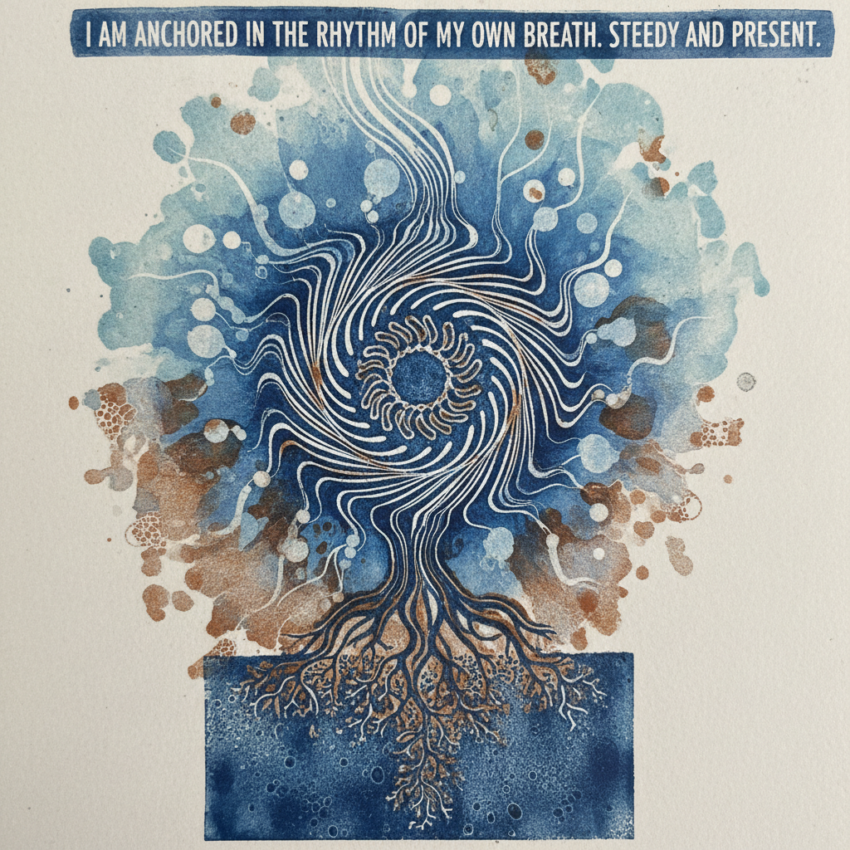
Today, let this be enough: one breath, fully felt. Not as a performance of wellness. Not as a technique to master. But as a homecoming — a return to the body you have been living in all along. Place your hand on your chest or your belly. Feel the rise. Feel the fall. Let the affirmation settle not as words to repeat but as a truth to recognize: you are already breathing. You have always been anchored here.
Carry this with you today. When the noise rises — when the screen pulls, when the tension gathers behind the eyes — return to one breath. Just one. Feel its full arc. Let it remind you that presence is not something you build. It is something you uncover, twenty thousand times a day.