The Chair That Was Already Ours
We noticed it this morning — that familiar hesitation before sitting down. Not at a meditation cushion, but at the kitchen table, at a desk, at the edge of a conversation. That half-second where we pulled ourselves inward, made ourselves a little smaller, as if the space we occupied needed to be earned first. As if there were some threshold of improvement we hadn’t yet crossed, some better version of ourselves waiting in the wings who actually deserved to be here. The coffee was already getting cold. The chair was already pulled out. And still, we paused.
It was a gray morning in many of our corners of the world — the kind of flat, overcast light that doesn’t flatter anything, that shows the dust on the windowsill and the circles under our eyes with equal candor. Maybe that was part of what made today’s meditation land the way it did. There was nowhere to hide in all that honest light. No dramatic sunrise to borrow grandeur from. Just us, exactly as we were: tired in some places, restless in others, carrying contradictions we’d been trying to iron out for years.
The Weight of the “Future Self”
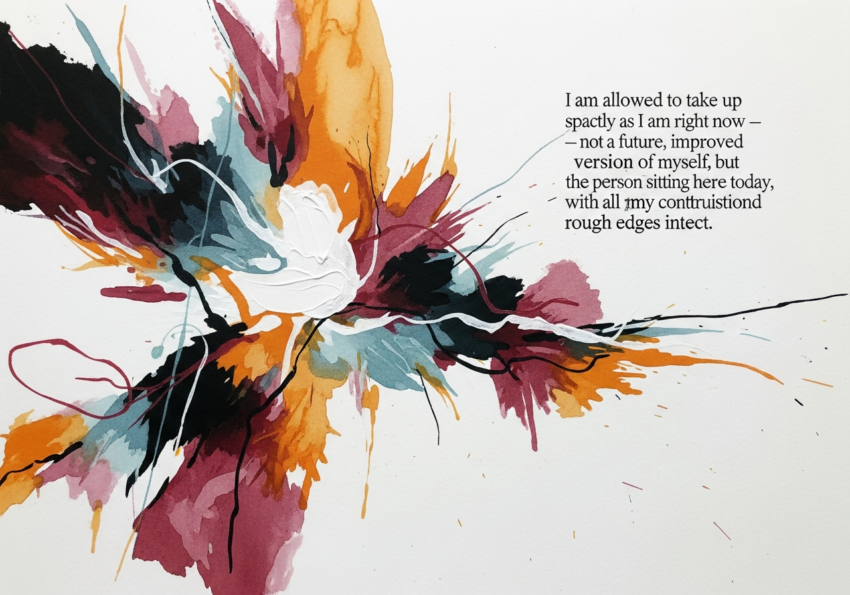
When we sat with the affirmation — I am allowed to take up space exactly as I am right now — something in the chest tightened before it softened. Because we realized how much of our energy has gone toward that imagined future person. The one who finally has it together. The one who meditates without fidgeting, who responds instead of reacts, who doesn’t eat cereal standing over the sink at 11 p.m. We’ve been deferring our own permission to exist fully, handing it forward to someone who doesn’t exist yet, and who — here’s the gentle paradox — never will. Because when we arrive at that future moment, we’ll just invent another, shinier version to chase.
We felt that loop today, really felt it in the body — the way our shoulders had been subtly braced, as though holding open a door for someone more deserving to walk through. And what a strange, exhausting posture that turned out to be. Not dramatic suffering, just a low hum of inadequacy so constant we’d mistaken it for personality. One of us described it afterward as “apologizing for being in my own living room.” That landed. A few of us laughed — the kind of laugh that has a crack of recognition running through it.
Rough Edges as Texture, Not Flaws
Something shifted when we stopped trying to smooth ourselves out and just… sat there. Contradictions and all. The part of us that craves solitude and the part that refreshes the group chat. The part that practices compassion and the part that silently judges the neighbor’s parking. We let those pieces coexist without picking a winner, without building a case for or against ourselves. It was quieter than we expected. Not a victory, not a breakthrough — more like setting down a bag we forgot we were carrying and feeling the blood return to our fingers.
Self-acceptance, we discovered again today, isn’t a conclusion we arrive at. It’s more like a posture we remember. We keep forgetting, and we keep remembering, and the space between forgetting and remembering gets a little more tender each time. Our rough edges didn’t vanish. They just stopped being evidence of failure and started being — what? Texture. Specificity. The actual shape of a life being lived by a real person, not a brochure for one.
Already Here, Already Allowed
By the end of the sit, the coffee was definitely cold. The overcast sky hadn’t changed. We hadn’t become measurably better people in twenty minutes. But we had, for a little while, stopped requiring ourselves to be different before we were allowed to be present. And that turned out to be enough — more than enough. It turned out to be the whole thing.
If you spent today waiting for permission to take up space, consider this your reminder: the chair is already pulled out. The room already has your shape in it. You don’t need to arrive as anyone other than who you woke up as this morning. Sit down. The coffee can be reheated.