
The Jar on the Windowsill
There was a jar on the kitchen windowsill this morning — an old mason jar filled with pennies, most of them dull and green with age. We noticed it the way we sometimes notice things we’ve stopped seeing: suddenly, completely, as if it had just appeared. And something about those corroded coins struck us as familiar. We’d been carrying things like that — small, heavy, tarnished grudges we’d tucked away so long ago we’d forgotten what they even cost us. The morning light hit the jar and made it glow a little, and we sat down with our coffee and thought about forgiveness. Not the grand, sweeping kind. The quiet, kitchen-table kind.
We’d been holding onto a conversation from years ago — some of us a sharp remark from a parent, others a betrayal by a friend, a few of us an old wound from someone who probably doesn’t even remember the moment. The weight of it had become so familiar it felt like part of our skeleton. We’d mistaken it for who we were. Sitting with it this morning, we noticed how our shoulders had been pulled slightly forward, how our breathing was shallow, how our jaw held a tension we hadn’t asked for. The body keeps the ledger even when the mind has filed the case away.
What We Thought Forgiveness Meant
For a long time, we thought forgiveness meant saying “it was okay.” It meant excusing, pardoning, minimizing. It meant pretending the wound hadn’t happened, or that it didn’t matter, or that we were somehow above being hurt. And because we couldn’t honestly do any of those things, we held on. We kept the resentment in the jar. We polished it sometimes, late at night, turning it over in our hands like proof of something — proof that we had been wronged, that our pain was real, that we mattered enough to be injured. There was a strange comfort in that proof.
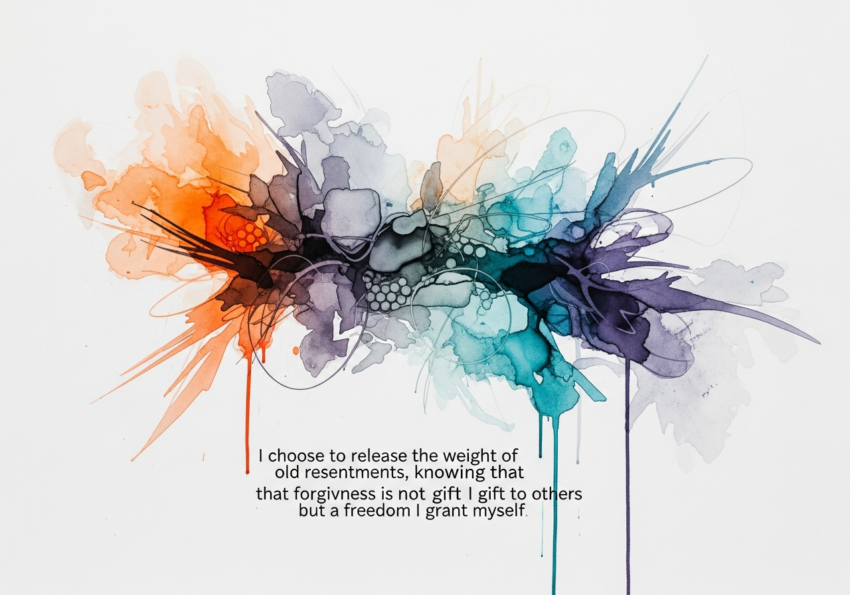
But this morning, something shifted. Maybe it was the quality of the light, or the particular tiredness we felt, or just the readiness that comes when it comes. We realized that forgiveness isn’t agreement. It isn’t a verdict. It’s not even really about the other person at all. It’s about setting down the jar. It’s about noticing that our arms are tired, that the coins have no value anymore, and that we’ve been guarding a treasure that was only ever a burden. We didn’t have to call anyone. We didn’t have to compose a speech. We just had to open our hands.
The Breath After Letting Go
We sat in meditation and tried it — not forcing anything, not performing forgiveness, but just allowing ourselves to feel what it might be like to not carry the weight for a few minutes. We breathed in and imagined the resentment as something with texture and color, heavy and dark in our chest. We breathed out and let a little of it soften. Not disappear — soften. There’s a difference. Disappearing is a magic trick. Softening is real. Some of us cried. Some of us felt a rush of anger first, which surprised us, and then a kind of exhaustion, and then a lightness behind the sternum that felt almost dangerous, as if we might float away without our familiar ballast.
One of the most honest things Ram Dass ever observed was that we are all just walking each other home. And sometimes walking each other home means walking away from the courtroom we built in our own minds — the one where we’ve been simultaneously the prosecutor, the jury, and the prisoner. We noticed today that the person we most needed to forgive was not always the one we expected. Sometimes it was ourselves — for staying too long, for not speaking up, for being human in a situation that demanded something more than human. The forgiveness that mattered most was the quiet kind we offered inward, toward the version of us that did the best they could with what they had.
What Remained
We won’t pretend the resentments vanished entirely. That would be dishonest, and dishonesty is just another kind of weight. But something loosened. The jar is still on the windowsill, but we stopped gripping it. We noticed that our hands, once open, could hold other things — the warmth of a mug, the softness of a dog’s ear, the hand of someone we love. Forgiveness, we learned today, is not a single event but a practice, a returning. Like meditation itself, it’s not about getting it perfect. It’s about choosing, again and again, to release what no longer serves the life we’re actually living.
If you’re carrying something old and heavy today — a grudge, a regret, an argument that ended years ago but still replays at 2 a.m. — we invite you to sit with it for a moment. Not to fix it. Just to notice how much it weighs. And then, if you’re ready, to open your hands. Even a little. Even just for now.